Explore the Valley of Calm, the gentle story world where feelings can be noticed, named, understood, and carried with kindness.
The Valley of Calm
Each place in the valley has its own small history. Some were shaped by water, roots, wind, or light; others appeared when the valley first learned how to hold a feeling safely.
What The Map Helps Children Notice
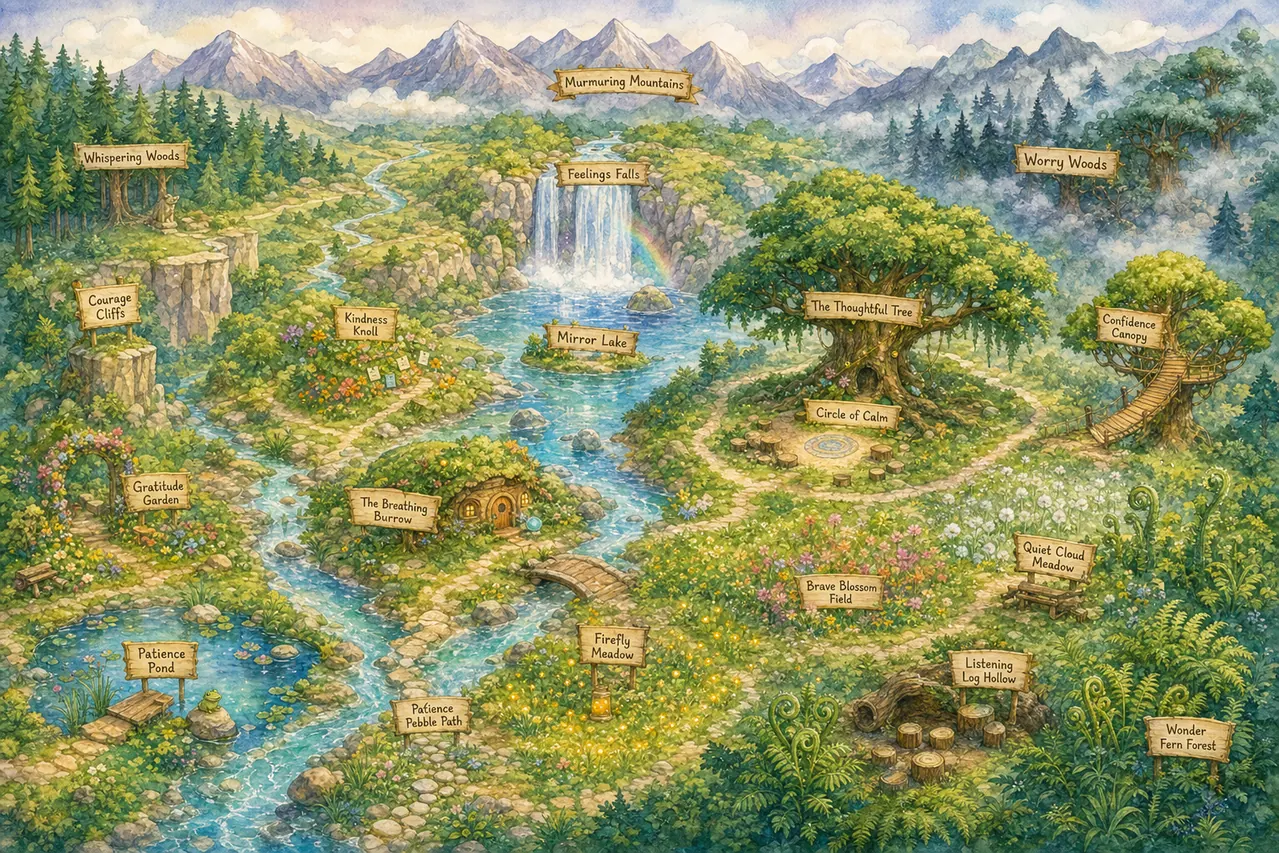
The Valley of Calm map gives children a visual way to connect places with feelings. A worried child might start in Worry Woods, a child building confidence might visit Confidence Canopy, and a child who needs quiet might imagine Quiet Cloud Meadow. The map turns emotional language into a landscape that can be explored gently.
Each location is a story doorway rather than a test or diagnosis. Children can point to a place, choose a feeling, or talk about where they would like Menthol Elf to go next. This makes the map useful for bedtime chats, classroom reflection, calm corners, and story planning activities.
Adults can use the places as prompts for open questions: What might help here? Who could listen? What small brave step could happen next? The goal is not to fix a feeling quickly, but to help children notice that feelings move, helpers matter, and calm can be practised one small step at a time.
As the Menthol Elf story world grows, the map can support books, printable resources, classroom displays, and family activities. Returning to the same places helps children build familiarity, emotional vocabulary, and a sense that big feelings belong somewhere kind and understandable.
For younger children, the map can be used very simply: choose a place, name one feeling, and imagine what Menthol Elf might do there. Older children may enjoy comparing places, noticing how worry differs from courage, or creating their own journey from a difficult moment toward support and steadiness.
The map also helps adults keep conversations concrete. Instead of asking a child to explain everything at once, an adult can begin with a shared image: a foggy wood, a quiet meadow, a listening hollow, or a bright field where brave tries can grow. That shared image can make the first words easier to find.
In classrooms, the map can become a shared emotional vocabulary wall. A group might place a marker near Patience Pond before a waiting activity, visit Listening Log Hollow before partner work, or return to the Circle of Calm after a difficult playground moment. The places give adults a consistent language that children can learn over time.
At home, the map can be used in quieter ways. A child might choose one place before sleep, draw a path through the valley after school, or point to a place that feels close to their day. The map is not there to make children talk before they are ready; it is there to offer a gentle starting point when words are hard to find.